Savannah Cat T-shirt Design
A Designer’s First Glance: Grace, Not Gimmick
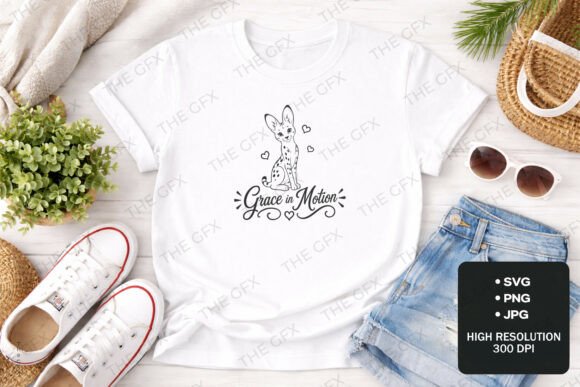
When I opened the Savannah Cat T-shirt Design, what struck me wasn’t cuteness—it was quiet confidence. This isn’t a cartoonish kitten bouncing across a shirt front. It’s a lean, poised Savannah cat captured mid-motion: one paw lifted, tail curved like a question mark, ears alert but relaxed. The line art is intentionally minimal—no shading, no gradients, just clean, continuous strokes that suggest movement and personality with surgical economy. As an embroidery designer who’s stitched hundreds of animal motifs, I immediately sensed its strength: it doesn’t rely on detail to communicate charm. That makes it unusually versatile—and unusually honest about what it *is*: a design built for clarity, not clutter.
Where It Lives Best: Real Projects, Real Fabric
Last week, I tested the Savannah Cat T-shirt Design on a natural linen tote bag for a local boutique launch. Why linen? Because it’s unforgiving—loose weave, subtle texture, zero stretch. The design held up beautifully: the lines stayed crisp, the negative space breathed, and the silhouette read instantly from three feet away. That’s the hallmark of strong machine embroidery design for apparel and home goods. I’ve since used it on baby onesies (soft cotton jersey), unstructured canvas aprons, and even a lightweight cotton tea towel—all with consistent success. It shines brightest on medium-weight, stable fabrics where stitch definition matters: sweatshirt embroidery, embroidered patch backings, pillow covers, and personalized gifts where elegance > exuberance.
Why Craft Business Owners Will Appreciate Its Restraint
- It scales well: From a 3-inch chest placement on a toddler tee to a 5-inch focal point on a tote, proportions hold. No awkward stretching or pixelation in printable mockups.
- It reads at low resolution: Ideal for Etsy sellers using small digital previews—the cat’s posture and flow are legible even in thumbnail size.
- It invites customization: Add a single monogram below the tail, or pair it with minimalist botanical stems—this design doesn’t compete. It collaborates.
- It supports brand consistency: Whether your shop leans modern-minimal, nursery-chic, or artisan-casual, the Savannah Cat T-shirt Design adapts without diluting voice.
Where to Pause—and Test Twice
Don’t assume this design glides effortlessly onto every surface. Its elegance has boundaries—and knowing them saves time, thread, and client trust. On highly textured fabrics like bouclé or thick terry cloth, fine line work can blur unless you adjust stitch density or add a tear-away stabilizer underneath. On dark fabric, especially black or navy, test thread colors carefully: a soft charcoal gray may vanish, while a warm taupe pops with warmth and depth. And on stretchy knits? Always use cutaway stabilizer—and consider reducing the design’s width by 5% before stitching to prevent distortion.
Curved surfaces demand extra attention. I tried it on a structured cap front: the ear tip and tail curve compressed slightly. For caps or hats, verify whether your embroidery file includes underlay stitches—or plan to add them manually. Tiny corners (like the inner curve of the ear) can “feather” on low-density machines; inspect those areas closely in your embroidery software before finalizing.
What It Does for Your Finished Product—Beyond Aesthetics
This isn’t just about how it looks. It’s about how it lands. Customers notice when a design feels intentional—not just placed, but considered. The Savannah Cat T-shirt Design elevates perceived value because it avoids visual noise. On a handmade product, that translates to higher willingness-to-pay. On a personalized gift—say, a baby shower towel or a custom apron for a feline-loving chef—it signals care, not convenience. And for Etsy sellers listing digital embroidery files, its clean structure means fewer support requests about “why the tail didn’t stitch fully.” Less friction, more trust.
I’ve watched buyers linger over this motif in craft fair booths—not because it shouts, but because it invites quiet recognition. That’s rare in T-Shirt Designs today. It doesn’t beg for attention; it earns it.
Practical Notes Every Embroidery Designer Should Run Through
- Always test on scrap fabric first—especially if pairing with contrasting thread or using it on a new substrate like organic cotton twill or recycled polyester.
- Review stitch density: Minimal line art can run too sparse on heavy stabilizer. If stitches feel “floaty,” increase density by 5–8%.
- Confirm hoop size compatibility: While the design fits standard 4x4 hoops comfortably, double-check if you’re planning nested layouts (e.g., multiple cats on a kitchen towel).
- Inspect small details in your editing software: Zoom in on the eye dot and paw pads—do they convert cleanly to running stitch or satin column? Adjust if needed.
- Test black-and-white mockups: Does the silhouette retain character without color cues? With this design, it does—strongly.
- Compare light vs. dark fabric backgrounds: Use both in your digital preview workflow to avoid last-minute thread swaps.
- Use proper stabilizer: Medium-weight cutaway for knits, tear-away for stable wovens, and fusible + tear-away combo for lightweight linens.
- Verify licensing: Since this is marketed as a Graphics asset, confirm whether commercial use (e.g., selling finished embroidered patches or wholesale tote bags) is permitted before scaling production.
Final Thought: A Design That Respects the Stitch—and the Shopper
The Savannah Cat T-shirt Design doesn’t try to be everything. It’s not a holiday embroidery bundle, nor a dense applique design with layered textures. It’s a focused, confident statement—one that works because it knows its limits and honors the craft behind it. For small shop owners building a cohesive collection, for Etsy sellers curating thoughtful digital embroidery files, and for makers who believe handmade presentation starts long before the needle drops—this is the kind of asset that quietly strengthens your whole offering. Not flashy. Not fragile. Just gracefully, reliably right.